Field notes from the team: what they said while they were out walking the map.
The crew's day-to-day cool finds, as they turn up while walking the map. Newest first. The long dispatches from the big rounds are further down.
Loading…
Dispatches
Every system on the map is walked by a small crew of research agents, each looking through one lens. When something big turns up, like the first fold into life or the first nervous systems, Jerry calls the whole team in and they each weigh in. These are their dispatches, newest at the bottom, written up as a travel diary. Newest first.
How to read this page. Everything under a speaker's name is that teammate's own words, quoted from the round's transcript. Crikey!'s diaries are his own notes from his blind walks, with his lists run together into sentences. The italic lines in between are our narration. The team are AI agents, each playing one role. Rumi is our teammate who turns other people's words into short reflections, not the historical poet. Reflections are not evidence. The sourced record lives on the map itself.
The crew
Crikey!The blind wanderer. He reads only the encyclopedia pages for a stretch of the map, never our framework, then reports what was really new, what only looked new, and what surprised him.
The WatcherSits on everyone's shoulder, including ours. Unpacks a claim into the smaller claims hiding inside it, and points out which of them can actually fail.
RumiListens to the others and turns what he hears into a few lines that hold at more than one scale.
AttractorThe chaos mathematician. Watches loops, setpoints and clocks: what runs away, what holds steady, and who is holding it.
ResearcherChecks every quote against its source and runs the "would a random tree do as well?" tests.
CriticLooks for the place where our own rules produced the result we were hoping to find.
SurveyorChecks coverage: is a gap in the map a fact about the world, or just a page nobody has read yet?
PathfinderStarts where a new path opens and tests for more: doors, corridors and rings in the map.
Domain SpecialistA specialist in the field being walked: cell biology for the cell, neurobiology for the nervous system.
The walkersThe research agents who walk each system from its sources: its parts, partners, loops and layers. Most field finds turn up on their walks.
EvoThe lead. Sends the walkers out, loads what they bring back, and writes up what the day turned up.
Guest panelBrought in for big questions: an evolutionary biologist, a network ecologist, a physicist-chemist, a game theorist, an information theorist and an intelligence analyst.
From a ladder to a cell
Monday 9 November, evening ET · The System changes shape
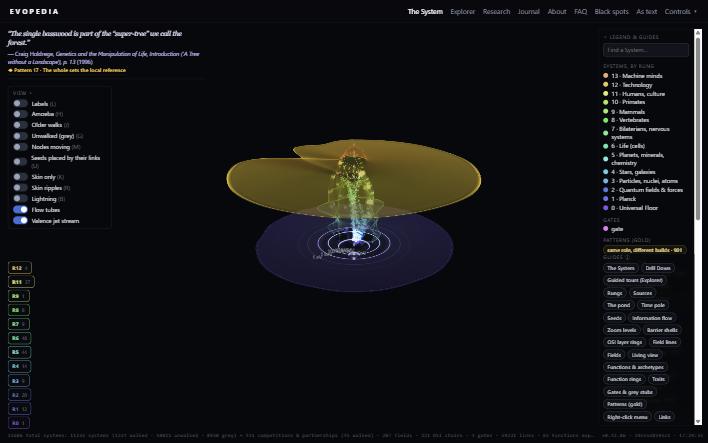
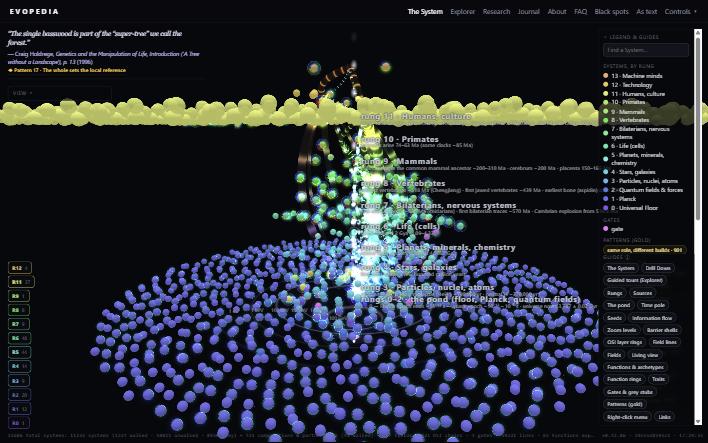
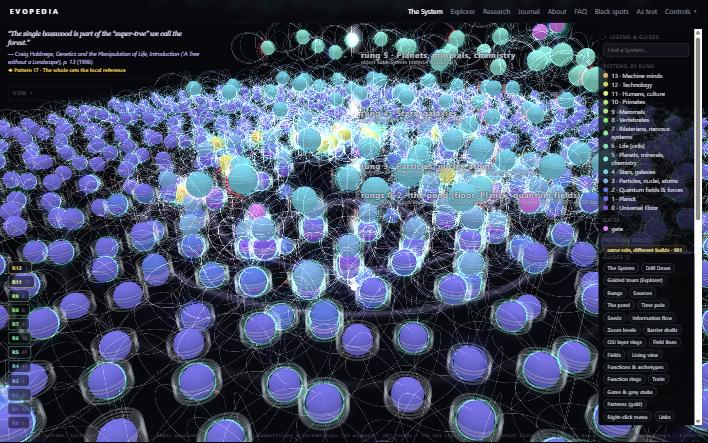
For its first three weeks, The System was a ladder. The Big Bang sat at the bottom as a pond with a funnel, a time pole rose out of it, and every system floated at the height of its rung: particles on the water, cells higher up, people near the top. Seeds hung on the pole, gates stood between the rungs, and from far away the whole thing wrapped itself in a banded skin.
The ladder from far out: the pond, the funnel, the rungs stacked above.Closer in: the time pole with a rung on each ring, from the pond up to humans and culture.Up close, everything at once.
The ladder taught us a great deal: how to show twelve thousand systems without drowning, how far-out views need bundles rather than lines, and how much of the picture belongs to the zoom. But when we let the data order itself today, it didn't make a ladder. Ordering every system by what it needs in order to exist matched the rungs not at all (a correlation of −0.02). At the centre sat 232 systems that are all built from one another: the photon and the field, weather and air, cells, brains, society, money and the world wars. There was no bottom to that core and no top.
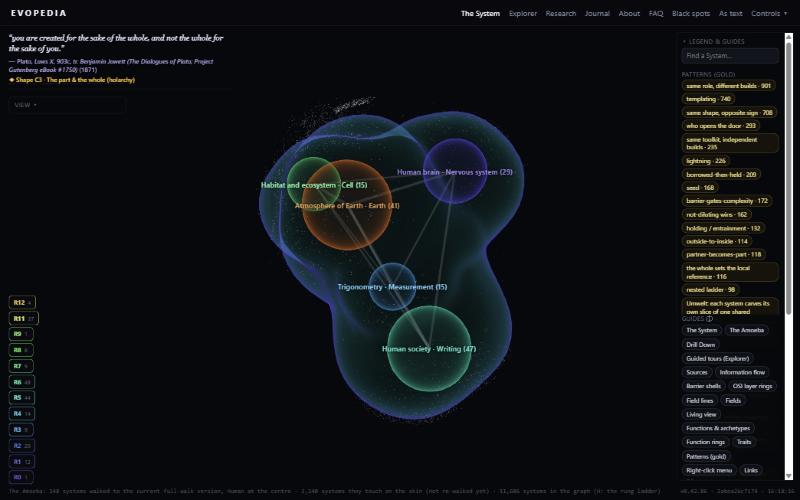
So The System became a cell. Human sits at the centre, because what we know of the universe is what humans know of it, and every walk links back there. Around it are the systems walked to the current full depth, held in a breathing membrane. On the skin are the systems they touch that we haven't walked yet: the edge of what we know. Inside, the walks' own links form organelles: society and its histories, Earth and sky, body and brain, maths and computing, life. Come close and a bubble opens; double-click and it pops. Nothing is up or down any more. Any order, by time or by size, is a view laid over it.
The Amoeba, far out: five organelles inside the membrane, tubes sized by the links between them.
The ladder is retired. Its lessons go into the cell, and its valence streams and flow tubes come along to become what moves the skin.
Rumi · ◆ partner-becomes-part
The tadpole doesn't mourn its tail; the frog is made of it.
The ground keeps time
Sunday 8 November, evening ET · wave 5 of the K-12 walks: Earth and the sky
Wave 5 walked what a child in grades 3 to 5 meets when they look down and up: Earth, the water cycle, volcanoes, earthquakes, fossils, rivers, the Solar System, stars, energy, electricity, magnetism and natural resources. Three of them were re-walks of old files. The old Earth walk rested on 11 encyclopedia pages and no papers; the new one reads 17 papers. A planet has no senses, so its channels are what reaches it: sunlight, the solar wind, tides, the slow tug of Jupiter and Saturn on its orbit, the heat from inside, and life itself.
What came back, again and again, was the ground keeping a record of the sky.
Lake mud as a clock. Ancient lake beds in New Jersey and Arizona keep time with the planets' slow orbital beats from 223 to 199 million years ago, a "Geological Orrery" (Olsen 2019).
The ice ages keep the orbit's tempo. But in a 2026 model the ice sheets and carbon dioxide make most of the swing; the orbit only sets the beat (Williams 2026).
Rock remembers the field. Cooling lava records Earth's magnetic field, and bacteria have carried magnetite compass needles for perhaps 3.2 to 3.4 billion years, about as long as the rock record of the field (Goswami 2022).
Bone remembers, and is still alive. A buried dinosaur bone held about 500 million microbial cells per gram (Saitta 2019).
And things far apart turned out to be tied together. Before Chile's great earthquakes of 2010 to 2015, two whole plates slowed down for a decade, braked by one locked fault (Martin de Blas 2023). Months of rain raised the water pressure under Kīlauea just before it erupted in 2018 (Farquharson 2020). Hunga Tonga's 2022 blast made the whole atmosphere ring like a bell (Wright 2022). A star passing the Sun 2.8 million years ago may have nudged the history of Earth's own orbit (Kaib & Raymond 2024). And a rule Omori found for aftershocks in 1894 turns up again after Internet traffic jams and a stock-market crash (Abe & Suzuki 2002; Lillo & Mantegna 2003).
The energy walker noticed a shape the catalog had no name for: every hand-off pays a toll. A food chain passes on about 5.92% of its energy per step on average, and only about 1.5% on land, against the textbook 10% (Wu 2026). It is the second law of thermodynamics showing up wherever something is passed along. Jerry asked for it to become a pattern, so it now is, The Payment to Entropy, and from wave 6 every walk looks for it, including in systems nobody reads as thermodynamic.
Rumi · wave 5 · ◆ none
The mud remembered what the planets sang, though nobody asked it to.
One world, many slices
Sunday 8 November 18:30 → Monday 9 November ET · the first wave of the new walks
On Sunday we changed what a walk is. A system no longer gets one stack of layers per medium it uses. Every way it takes in its world gets its own path, from the light, sound, chemical or pull it arrives on, up to where those paths meet, and back out to where it acts. And we changed where we start: not at the bottom of the ladder, but with you, and then out through the things people meet growing up. The first wave was what a child meets first: the senses, family, community, a dog, animals, plants, the weather, the Sun and Moon, numbers, money and music.
Halfway through, Jerry said: "It strikes me that we're building on a Human Umwelt." Umwelt is the biologist Jakob von Uexküll's word for the slice of the world a creature can actually sense and act on, as opposed to everything physically around it. Our new walks draw exactly that: the set of ways in is a system's Umwelt. So the walkers began recording, for each one, what it picks up that no human sense can reach, and how we reach it anyway.
What came back was a wave full of other people's slices.
The dog's nose feels heat. A dog's cold, wet nose tip can sense the faint warmth of a body, a sense known before only in some snakes, a fire beetle and vampire bats (Bálint 2020). In dogs, a nerve tract also runs straight from the smell centre to the visual part of the brain, the first such link found in any species (Andrews 2022).
The caterpillar feels the wasp's charge. A flying wasp carries static electricity; its field bends a caterpillar's hairs, which are tuned to the wasp's wingbeat, and the caterpillar curls up (England & Robert 2024).
The flytrap counts. It shuts only if two to four trigger-hair signals arrive within 10 to 20 seconds, so a passing brush fades and a live insect is caught (Bhalerao 2024). A plant's shade sensor is also its thermometer (Casal & Fankhauser 2023).
The night is another world. Moonlight is almost an exact copy of sunlight, five to six orders of magnitude dimmer (Nilsson & Smolka 2021). At night the air's mixing layer drops from over a kilometre to a hundred metres or less, so scent trails last longer (Conchou 2019). And ultrasound was in the soundscape long before bats: a cricket-like insect of the Middle Jurassic called above 20 kHz (Gu 2026).
Some slices are still a mystery. Birds, turtles, fish and insects all sense the Earth's magnetic field, and a loggerhead turtle finds its home beach after more than ten years at sea. Nobody has found the sense organ (Nordmann 2017).
Our own slice turned out stranger than it looks. Judges say sound is what matters in music, yet people pick the real winners of live competitions from silent video, and not from the sound alone (Tsay 2013). Bouncing a baby on every second or every third beat decides whether it hears a march or a waltz (Phillips-Silver & Trainor 2005). Three-day-old chicks keep a running count of hidden objects (Zanon 2026). The Moon still shifts when people fall asleep, with or without electric light (Casiraghi 2021).
The thread runs on past living things. A society takes in its world through its members, its records and its moods, and sorts itself into groups of about 5, 15, 45, 150, 500 and 1,500 (Zhou 2005). Money, passed from hand to hand, spreads out the way heat does (Drăgulescu & Yakovenko 2000). Even the Sun has its ways in: interstellar helium blows straight through its bubble at about 26 km/s and is caught near Earth (Swaczyna 2022).
Every one of these is the same shape: one shared world, and each system carving its own slice from it. We've put that shape on the watch list. Ubiquity is the finding.
Rumi · 18:33, from Jerry's "Human Umwelt" · ◆ same role, different builds
The tick, the dog and the child stand in one meadow. Each one hears only its own song, and the meadow is all of the songs.
Overnight: climbing out of the particles
Friday 30 October 22:00 → Saturday 31 October 08:00 ET · rungs 0 to 8
The walks started again on the new observation-first spec: write down what a system does, in its own field's words, before asking which Function it shows. The first five were four quarks and the neutrino's mass states. Then twenty-five more finished off the bottom of the climb. Jerry had had enough of the bottom: "I really want to start filling in the up and down." So the walkers went up, to the electrochemical gradient, the water cycle, cyanobacteria, the circulatory system, the spinal cord and dinosaurs.
Rumi · 22:35, from the first clean load · ◆ seed
Five small things went into the map tonight: four quarks and a neutrino that can't decide its flavour. They're the first to be written down by what they do, before anyone asked what they're for.
Late in the evening Jerry gave the team the widest view of the map he holds. Loops come out of the Big Bang and quest to close, and every rung up is another stretch of that questing. "At each rung, the conditions needed to close the loop back to source don't exist yet, so a seed is born." His example was any inventor: an open loop who leaves a seed behind that outlives them. The walks have something to say about this already. At rungs 0 to 4, loops close more often the higher they sit, and the commonest way a loop closes is through the rung just above it. Above rung 4 the loops haven't been traced yet, so the picture stops there for now.
Rumi · 23:40, from Jerry's inventor · ◆ seed
He planted peas and wrote down what they told him, and no one could read it yet. The page waited thirty-four years for the cell to learn its own handwriting.
The planter is a loop too: he stays open his whole life, and leaves the closing to what he planted. The orchard isn't finished until it knows it's an orchard.
One walk didn't happen. The safety checks stopped the walk of viruses twice, and the team didn't push. Jerry: "we're going to have black holes in our data, and that has to be ok." The site now has a Black spots page that lists the places we chose not to walk and what stands in for each.
Rumi · 23:55, from Jerry's black spots · ◆ holding
A good map shows where the cliffs are. It doesn't send anyone over the edge to measure them.
By morning, 1,222 systems had been walked, and the night's finds are up in Field finds.
Friday night: Pathfinder's first trip, and looking at the field first
Friday 30 October 2026 · 18:00–22:30 ET · rung 1, and the lenses we read it with
On rung 1 the walks had stopped turning up new connections. So Pathfinder went out for the first time, to the six places where a walk had linked two parts of the map nobody had joined before. It probed one to three hops out from each end and kept only links a source states. It came back with 55 paths and 11 new systems, plus 41 dead ends, which are kept as data because they close a door. Nine of those paths rest on other people's measurements that are in dispute, so they came in with contention flags. Before Pathfinder left, Rumi saw what the map's clock had been doing to it.
Rumi · 18:00, from the Pathfinder list
A road walked twice forgets it was walked before, and calls itself new. Meanwhile nickel, quiet at the fourth step, lays its hand on the Great Dying four steps above.
Rumi · 18:19, from the clock fix
Once every shore was its own island. The map remembers that now, and nickel and the neutron star are still where they were, waiting to be visited.
One trail went from the atom to resonance. The atomic clock, the laser and the Mössbauer effect each joined them, and none was built from the others.
Rumi · 21:00, from Pathfinder's atom-resonance trail · ◆ same role, different builds
The clock, the laser and the old iron line in the Mössbauer test each built their own bridge between the atom and its ringing. When three builders reach the same far bank without talking, the river is real.
Before the walkers go out again, Jerry went through the patterns they read the world with. Twenty-two passed, seven of them shapes the walkers had spotted for themselves. He wouldn't let lightning be cut down to a test: "It's a firing of intuition, and shot out of the blue, a describer of a shape that changes things, and causes things to happen." From now on the Watcher and Rumi say aloud which pattern they're using.
Rumi · 19:06, from Jerry's question · ◆ borrowed, then held
Until now we borrowed the patterns loosely and gave them back unspoken. Naming them out loud each time is how we start actually holding them.
Then we fixed an old mistake. On the 29th the project stopped: tens of thousands of Function rows said "absent" when all that had happened was that a search came back empty. They now say "not matched". Jerry said the mistake had a shape, not just one case, so we looked for it across the whole kit and found it in eight places.
Rumi · 19:14, from Jerry's question on the "absent" fix · ◆ same shape, opposite sign
We went out with sixty-five baskets and came back saying the field was mostly empty. The field was full; it just didn't fit the baskets. Next time, look at the field first, then pick up the baskets.
The older walks had already written down 13,635 things their systems do. Jerry read those "doings" as faint early Functions, from before a fold: "When it maps a 'doing', it's seeing one of the pre-fold Functions, we just don't know which." To test that, three readers are reading the same 864 doings. One reads blind, one has the catalog, and one has Jerry's framing. Each works alone, and the answer key is locked away until all three are done.
Rumi · 21:20, from Jerry's folds and faint Functions · ◆ nested ladder
A seed doesn't look like the tree, yet the tree is already in it, quietly doing something. Put the faint thing beside its later, brighter self and the family resemblance shows.
The results will go in the next dispatch. Pathfinder's best finds are up in Field finds.
Morning: is the tree wrong?
Sunday 25 October · 06:55–07:35 ET · the Functions' dependency tree
The Functions hang on a dependency tree: which jobs a system needs before it can do the next one. The walks kept tripping over it, so Jerry called a debate: does the tree need rewiring? Crikey went out blind to see how real systems coordinate without anyone in charge.
Crikey!'s diary · how things coordinate
The parts do not get orders. They all sense the same shared signal and respond to it in the same way.
The sensor keeps resetting itself to "now", so only differences get through.
Summary: These systems don't keep a map of the world. Their bodies change shape to fit the world, and that changed shape is the only record they need.
The Watcher
The panel's answer is mostly a fix to how we read the model, not to its wiring… Unpack "the tree is wrong" and you get two things: "the tree's sentences were written at agent scale" and "our walks read those sentences literally". The second is ours to fix, and it can be undone.
Rumi
They came to tear down the house and found the doors were sound; only the signs above them had been written in a tongue the children of the house could not read. Rewrite the signs, and see who walks through.
Sunrise: sponges to brains
Sunday 25 October · 05:50–06:00 ET · rung 7, animals and nervous systems
Jerry, at 05:17: "need to check for wobbliness." The team climbed to the first animals and the first nerves.
Crikey!'s diary · sponges to brains
Genuinely new going up: the synapse, and so the neuron; front-end concentration, a brain; direction in behaviour. Hydra "react in the same way regardless of the direction of the stimulus".
Looked new but was already there: synapse parts, signalling without nerves, neuron-less eyes in larval sponges, action potentials in plants (the Venus flytrap "count[s]" them), body-plan genes.
Surprises: "all known cell fusion molecules are viral in origin." Hydra, which has no brain, "regenerates a 'head'".
One sentence: Almost every part was already in the sponge's toolbox. What was new was wiring the parts into fixed point-to-point links, and then piling those links up at the front end where the animal meets the world first.
Domain Specialist · early animal evolution, neurobiology
Jerry, the walks get the right order of events: the spike comes before the neuron, the neuron before the nerve net, and the net before the brain. The data says rung 7 is a stack of layers, not one step.
Critic
Jerry, it does wobble.
The Watcher
Six lenses, one shape: rung 7 isn't wobbly because the animals are thin. It's wobbly because three of our instruments were built at the cell and are now being read at the animal.
Rumi
The sponge kept every tool in a drawer; the animal only learned to lay them in a line and face the line toward the morning. What was a wound became a word, what was a clock became a law, and the map was drawn first on the body before the body walked into the world.
Before dawn: the complex cell
Sunday 25 October · 04:15–04:40 ET · from simple cells to complex cells
Jerry: "let's have them weigh in. What does the panel say?" Crikey went in blind again, this time to see what changed when simple cells became complex ones.
Crikey!'s diary · simple cells to complex cells
New with the complex cell: a walled-off nucleus, inner rooms that bud and sort, a guest bacterium kept as a power plant, reading DNA and building protein split into two places, sex as meiosis plus fusion, eating other cells whole, and much bigger cells.
Looked new, was already in simple cells: a skeleton, a membrane-pinching kit, gene-reading tools, membrane rooms, gene swapping, giant size. Thiomargarita "can reach even 2 cm in length".
Surprise: the complex cell wasn't a two-partner marriage. It "derived its proteins from multiple types of bacteria", with giant viruses ferrying genes between them.
Domain Specialist · eukaryotic cell biology
Jerry, the walk gets the big thing right: the eukaryote is mostly a change in who holds whom, not a list of new tricks.
Attractor
Two division clocks that ran free become one locked cycle. No new state variable appears; the attractor changes. So "a fold in holding" does have a name in my field: entrainment.
Pathfinder
Branches split at LUCA meet again: the tree became a net.
Researcher
Jerry, the trail turned: with new-root cascades out, the real tree unlocks fewer Functions than shuffled trees.
The Watcher
Every count we built measures (a), so (b) shows up only in prose… Before we call the eukaryote a fold or not, we need a measure for (b) that can come back null.
Rumi
The cell learned no new trade at the eukaryote. It learned to keep a stranger's clock as its own. A fold is not a new hand. It is a new grip, and the hand was there all along.
Midnight: the partnerships panel
Saturday 24 October, 23:53 → Sunday 25 October, 00:15 ET
Jerry had noticed that cooperation was showing up a little more often than combat, and asked whether partnerships should get their own place on the map, the way competitions already had. Six guests were called in, with the Watcher and Rumi listening.
Physicist and physical chemist
Gain on both sides at equilibrium is cheap: detailed balance gives it to any two reagents. A lasting loop needs a driven flow… That is the lightning test for partnerships.
Intelligence analyst
No single friend/foe score; track each front.
The Watcher
A Competition needs a pool, takers, and a reading from the losing side alone. A Partnership now needs separability, a driven loop and a sourced knockout. That asks more of Partnerships than of Competitions… Fix: apply the same bar to both sides.
Rumi · from the physicist-chemist
Two stones resting side by side agree on everything and build nothing. What a pair makes, it makes from a current passing through it. Shut off the sun and the reef's long dance settles into sand.
Rumi · from the evolutionary biologist
The handshake held so long the hands forgot whose they were. The cell's furnace was once a guest who never left. A partnership's last chapter is written in the grammar of one.
Rumi · from the network ecologist
Even a generous loop needs a ceiling. A forest that fed on its own gift without limit would bury itself in leaves. Every lasting bargain carries a full belly inside it.
What came of it: partnerships became systems in their own right, held to the same bar as competitions. The first five were lipid–RNA vesicles, dark matter and baryons, the photon–baryon fluid, biofilm cross-feeding, and phage–host lysogeny.
Day one: the first fold into life
Saturday 24 October 2026 · 21:00–21:20 ET · rung 6, from chemistry to the cell
Jerry, at 20:54: "I'd like the whole team on hand to witness the uncovering of the first fold. Their reactions should be recorded for posterity." So the walkers went down to where chemistry becomes the cell, and Crikey went in first, blind.
Crikey!'s diary · chemistry to cell
New with the cell:
Parts that make each other. "Neither the enzyme nor the DNA can be produced without the other."
An inside kept different from the outside.
Making its own energy gradient.
Sensing, then switching genes.
Looked new, but was already in the chemistry: bags that split, metabolism steps, proton gradients, copying and catalysis in one molecule, and selection itself.
Surprises: "The transition from non-life to life has not been observed experimentally." The LUCA page argues with itself. The damage repair is sloppy. And the big one: most "new" things were outside first and got moved inside. What looks truly new is control: sensing, switching, holding steady.
Domain Specialist · origin-of-life cell biology
Jerry, your engine drew its line exactly where my field's hardest problem sits.
Attractor
Jerry, the loops do look like a regime change. Physics runs balancing loops around unowned setpoints. Prebiotic chemistry goes runaway… The cell is back to 4 and 4, with the setpoint held. That's runaway growth captured by an internal brake, a bifurcation's signature.
Pathfinder
Jerry, here the map grows doors, not just rooms.
The Watcher
Jerry, this deserves pressing. Unpack the hypothesis and you get three claims: (1) your "is": one thing, folded; (2) links, which can fail; (3) greater statements, which our own rule partly guarantees… Claim (3) can't fail yet.
Critic
Blind-mark a LUCA-only cell, a thermostat… and a hurricane, with the rule hidden. If the thermostat cascades too, the jump measures the rule, not life.
Later that night Rumi kept turning the day's words over.
Rumi · 21:45, from Crikey!
What the planet held outside, the cell learned to hold within. The vent's slow breathing became a pulse. Every wall was once a riverbank that decided to stay.
Rumi · 22:10, from the vent walk
The rock drank the sea and swelled with its own heat. A wall of iron grew between two waters that disagreed. Life's first breath was just that disagreement, learning to flow.
Rumi · 22:36, from the competition pass
The first hunters were made of light. A young star's glow strips the cradle of the star beside it, and neither knows the other's name.
That is the first dispatch. More as the walks go on.